My Journey
From First Tesserae to Fine Art
My mosaic journey began unexpectedly in 2008, while I was living in an expatriate community in the suburbs of Moscow. There, I met a small group of women who gathered weekly, to make mosaics from ceramic bathroom tiles. Outside, nearly three feet of snow lay blanketing our homes through the long winter months. Inside, during dark afternoons, we met in the basement of our mentor’s home, drawn together by warmth, creativity, and companionship.
Over cups of hot coffee and homemade cookies, we found inspiration in one another’s mosaic designs. With only rudimentary tools, we cut these tiles into small tesserae and assembled simple mosaics, grouting them with powder grout. Those first works were humble—almost like school craft projects—but each completion felt like a small triumph.
We celebrated every mosaic with shared homemade meals and cheerful outings to tiny shops selling washroom fittings, where we searched for new colours and textures of tiles. Each new addition brought slightly more complex and more colourful designs into our mosaic creations. Unknown to me then, it was the collective enthusiasm of this group—the joy of making, learning, and continuing together—that quietly instilled in me a lasting spirit of possibility and a deep-rooted “can-do” confidence that would later guide my path as a mosaic fine-art artist.
What follows is a journey through my mosaic practice—from its early days as a quiet pursuit to the conscious decision to embrace mosaics as a fine art practice, shaped by evolving ideas and processes.
A Pivotal Moment
2010 marked a pivotal moment in my fine art journey towards mosaics. I accidentally heard that the third international contemporary fine-art mosaic exhibition, SOLO MOSAICO 2010, was showcasing in the art district of Moscow, organised by the Ismail Akhmetov foundation. Featuring works by contemporary grand mosaic masters such as Verdiano Marzi, (now teaching at The Chicago Mosaic School) and other international mosaicists, it was the grandest spectacle of contemporary fine art mosaics I have seen to date.
I emerged from the exhibition overwhelmed and quietly elated. The scale, refinement, and expressive depth of the works dissolved any remaining sense of mosaic as mere craft. The brilliance of materials, the command of form, and the way light animated every surface lingered in my soul. It felt as though a door had opened—revealing the immense, untapped potential of mosaic as a contemporary fine art. I resolved to dedicate myself to understanding it. Towards practising it. Finally becoming one with it.
The Beginning of A Serious Pursuit
Joining the Ismail Akhmetov Foundation at Moscow in 2010 became a turning point in my life. It opened a world of artistic refinement I had only glimpsed before, allowing me to attend lectures and, more importantly, to meet and learn from some of the most inspiring voices in the international contemporary mosaic fine-art community. I was deeply moved by my encounters with artists such as Sonia King from the United States and Marco Bravura from Italy, whose generosity in sharing their journeys, processes, and philosophies left a lasting impression on me.

An enriching moment with famous mosaicist Marco Bravura, during our study visit to the Ismail Akhmetov Foundation, Moscow in 2010

Listening to inspiring mosaic journeys shared by Sonia King and Marco Bravura

Three-dimensional mosaic sculpture by Marco Bravura, created for the forthcoming Solo Mosaic exhibition in Moscow.
During Marco Bravura’s year-long stay in Moscow, I had the rare opportunity to closely witness the making of his solo exhibition—from its earliest ideas to its final installation. Watching a body of work slowly take form was both humbling and exhilarating. It was in those moments that a quiet but powerful resolve settled within me: one day, I too would create and present an exhibition of my fine art mosaics – hopefully in my own country. From thereon, my path felt unmistakably set, and there has truly been no turning back.
A ‘Becoming’ in Mosaics : The Moscow Years
It often felt as though the universe itself was quietly aligning to deepen my resolve to master the art of mosaic. In 2012, two important developments gave fresh momentum and direction to my practice.
At the Ismail Akhmetov Foundation in Moscow, Italian mosaic masters introduced me to an ancient roman mosaic material that would profoundly shape my future mosaic work—smalti. The unique power of smalti lies in its ability to hold light within itself and give a miraculous glow to mosaics.
.jpg)
One of the giants of Italian mosaic art – Marco Bravura, himself taught me the use of the hammer and hardie tool, traditionally used to cut thick smalti “pizzas” into tesserae of varying depth and character. The luminosity and physical presence of this material brought a new dimension to mosaic, and I felt instinctively drawn to its expressive potential.
Hamamer and Hardie

Traditionally, smalti was available almost exclusively in the Venice–Ravenna region. During Marco Bravura’s residency at the Foundation, however, local artisans were trained to produce smalti, granting me access to this most prized material. It was a defining moment: the substance of historic mosaics had entered my own hands.
The Deesis mosaic
This discovery led me to Ravenna, to the renowned Mosaic Art School run by the famous Italian contemporary mosaicist, Luciano Notturni. Under her guidance and that of her fellow instructors, I deepened my understanding of this art—learning to cut not only smalti, but marble as well, and to compose mosaics using the ancient and flexible lime putty method. Most importantly, I learnt about the rules of classical Roman mosaic concepts in developing fine art mosaics – such as classical andamento, using borderlines to enclose a shape, line transitions, use of different tesserae cuts – the importance of the keystone cut, etc. More on these classical techniques under the tab Technique. When I returned to Moscow, my work had expanded in both technique and material language: ceramics, marble, and smalti now came together in my practice, with glass waiting on the threshold.
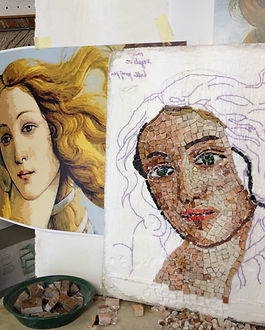
Learning the art of Roman-style mosaic portraiture in smalti and marble.

Using the traditional lime putty method to transfer the mosaic onto its final surface.

Group photograph with fellow mosaic artists and Ms. Luciano Notturni, Director of the Mosaic Art School.
The second defining event of that year arrived unexpectedly. Amalia, a Greek mosaic artist with many years of experience, joined our expatriate community and began teaching glass mosaic courses. As her classes flourished, she invited me to assist her with her students’ mosaic projects. Through this collaboration, I learned both the direct and indirect methods, including approaches suited for making mosaics on non-uniform surfaces. Teaching, in turn, became a powerful teacher for me. It clarified my understanding, helped me develop new ideas, and quietly nurtured a new confidence in my identity as a mosaicist.
And then came the move to Dubai. And with it, another wealth of experience too.
My Evolving Mosaic Art: The Dubai Chapter
The Dubai chapter (2014-2022) was my time to gather my learnings in mosaics and start delving into serious mosaic making of the classics. Alongside, I started working as a mosaic instructor at a prestigious Dubai art school. A major achievement was the making of large group mosaics with my students and their installation at various Dubai health facilities.
My initial mosaic works started as echoes of the ancient Roman ruins, where my fascination with mosaics had first taken root. These Dubai years in mosaic making were shaped by the classical geometry of Roman mosaics. From the sun-baked colour palettes of the ancient Roman mosaics, I slowly graduated to using contemporary colours widely available in glass tiles. Using a varied colour palette brought a fresh visual quality to these timeless Roman designs.
At the time, I saw myself as a quiet caretaker of the ancient established language of mosaics, repeating its patterns and grammar with reverence. Over the years, my art evolved to incorporate more fluid subjects and techniques.
In 2015, I was invited by Dubai Community Theatre & Arts Centre (DUCTAC), to teach mosaics to adult students. Given my past experience of teaching at Moscow, I accepted this opportunity, and started with training the students on the conceptualisation and the process of mosaic making.
My mosaic classes reflected my belief that mosaic-making is a slow, thoughtful process where technique supports intuition. I encouraged students to determine the subject they wanted to portray and the emotion they wanted to convey, and then choose the technique to be employed in their mosaic design to achieve their objectives. I encouraged them to work patiently, stay attentive to material and form, and remain open to discovery, allowing both their work and their understanding to evolve together.


The rough drawing establishes rhythm and movement for translation onto a circular vase. As tesserae take shape on the curved surface, the design shifts from line to light, standing ready for grouting and final unity.
In 2018, I shifted to the DIAC (Dubai International Art Centre) to teach mosaics. Many of my students from DUCTAC shifted with me.
Since 2014, I had individually tried making part mosaics on nylon mesh, and then assembling these parts together to make a mega mosaic. With repeated attempts, I perfected this methodology. From 2018, I taught this methodology to my students.
Mesh making technique
The highlight of the Dubai mosaic phase was the making of mega group mosaics with my students and installing these at various Dubai health facilities – The Dubai Thalassemia Hospital (Mandala Quartet), The Dubai Blood Donation Centre (Circles Of Flight) and the Dubai Stem Cell Centre (Storytelling In Mosaic). My students were delighted to learn this new mesh methodology of making mega mosaics and embraced it wholeheartedly. (See photos). While I conceived the overall mega mosaic, subsequently dividing it in parts, each student made their allocated part separately. Once done, the mosaic came together as a whole on an acrylic substrate.

Mandala Quartet- Felicitation and Installation
My subsequent mosaic journey has continued to evolve over the years. With my shift to India in 2022, I focus on evolving my own mosaic style and varying the techniques with the subject matters I choose.